Inclusion support centred in neuroaffirming and culturally responsive practice

Inclusive Early Learning provides inclusion support across early learning and home environments, centred in neuroaffirming and culturally responsive practice.

I work alongside children, families, and educators to build understanding, strengthen inclusive practice, and create environments where every child feels safe, seen, and supported in their development, communication, and wellbeing.

A diverse group of children sitting cross-legged on a carpet in a classroom, listening to a woman. A large sign with the Aboriginal flag and a statement about acknowledging traditional land is visible. The classroom has plants, framed artwork, and a motivational wall quote that says, 'You belong, you matter, you are enough.'
A cozy preschool or daycare classroom with small wooden tables and chairs, educational materials, toys, and books, with a window showing buildings outside.
A group of children sitting on the floor in a classroom, attentively watching a teacher and a young student using a tablet and a large screen to learn with picture-based communication symbols.
A group of adults and children sitting around a table in a classroom, engaging in a discussion. The table has educational materials, including sheets with pictures, a tablet, and a clipboard with an inclusion checklist. The classroom has bookshelves, decorated walls, and windows with a view outside.

Meet Our Founder

A woman with brown hair, wearing a pink checkered shirt, is smiling at the camera as she sits outdoors with two children. One child, with light hair, is in the foreground and partially visible, and the other, a young boy with short brown hair, is holding a slice of pizza. They are sitting at a table with cups and a piece of toast. There is a palm tree and a dark building in the background.

Hi, I’m Annissa, the founder of Inclusive Early Learning.

Inclusive Early Learning was created from lived experience, as a neurodivergent Biripi and Dunghutti woman, and as a mum who understands how much families are often required to advocate, explain, and push for support that should be accessible from the beginning.

Too many children experience barriers in education systems that weren’t built with their needs in mind, and too many families are left carrying the weight of making sure their child is understood, included, and supported.

I believe early childhood educators are gate openers to access. When inclusive practice is embedded early through environment, relationships, routines, communication supports, and co regulation, children don’t just cope in education, they belong, participate, and learn in ways that honour who they are.

My work focuses on building practical, neuroaffirming and culturally responsive approaches that support children in real, everyday moments, while also strengthening the confidence and capacity of the educators and services around them.

Because inclusion isn’t an extra. It’s a right.

A young woman with dark wavy hair smiling, holding two children in an outdoor setting on a sunny day. One child has short dark hair and is wearing a mustard yellow sweater, eating a green lollipop. The other child has light brown hair, wearing a reddish-brown top and black pants, and is also holding a lollipop.

Early Childhood Services and Professionals

Inclusion Check-In Inclusion Check-In
Quick View
Inclusion Check-In
$0.00

Best for centres that want clarity and next steps. Includes a focused consult, a quick review of what’s happening in your environment, and practical recommendations aligned to the EYLF, NQS, and children’s rights. You’ll leave with a clear, realistic action plan your team can implement straight away.

Implementation Support
$0.00

For centres ready to move from ideas to consistent, everyday practice.
I support your team with hands-on implementation: routines, visual supports, sensory and environmental adjustments, communication foundations (including AAC), and practical documentation that fits real early learning settings. Support is tailored to your classroom, your team capacity, and your children so strategies are sustainable, not overwhelming.

Professional Development

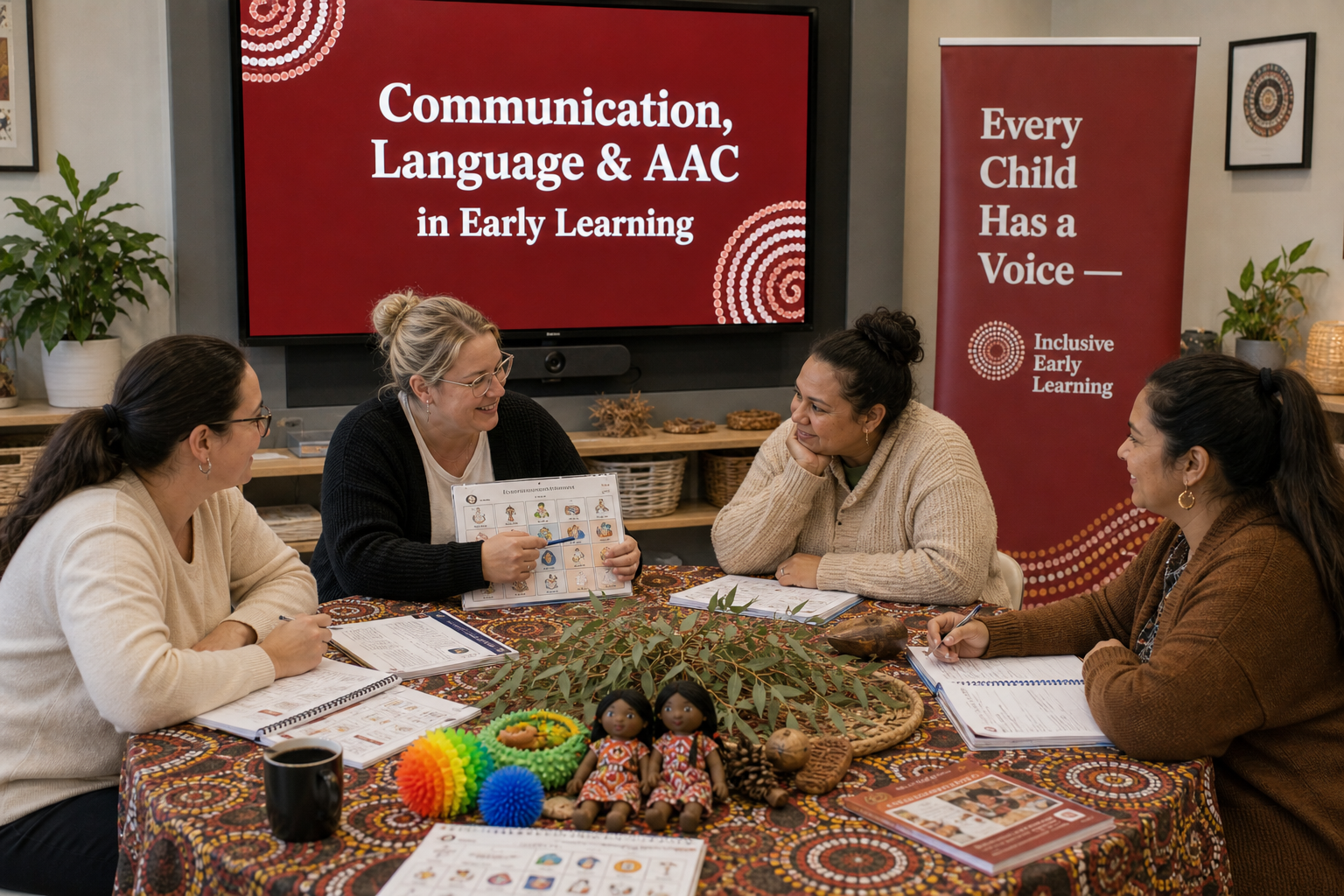
Communication, Language & AAC in Early Learning Communication, Language & AAC in Early Learning
Quick View
Communication, Language & AAC in Early Learning
$0.00

This professional development supports educators to understand, recognise, and respond to a wide range of communication styles in early learning environments, including children who are non-speaking, have language delays, or are Gestalt Language Processors.

Grounded in neuroaffirming practice, this session supports educators to move beyond traditional expectations of speech and build inclusive environments where all children can express themselves and be understood.

What this session covers

• Communication beyond spoken language
• Understanding and responding to diverse communication styles
• Supporting non-speaking children and children with language delays
• Introduction to Augmentative and Alternative Communication (AAC)
• Embedding AAC into everyday routines and play-based environments
• Understanding Gestalt Language Processing (GLP)
• Interpreting echolalia and scripted language
• Intentional language modelling to support development and connection
• Creating inclusive opportunities for autonomy, choice, and participation

Key Focus
This session focuses on creating flexible communication environments within early learning settings, ensuring all children have a voice in the classroom.

Educators will be supported to understand a range of communication styles and differences, and how to respond in ways that promote inclusion, autonomy, and meaningful participation.

Who this is for
Early childhood educators, support staff, and teams supporting children with communication differences, speech delays, language delays, or neurodivergent communication styles.

Delivery Options

• In-centre professional development
• Team workshops
• Small group training sessions
• Customised sessions tailored to your service

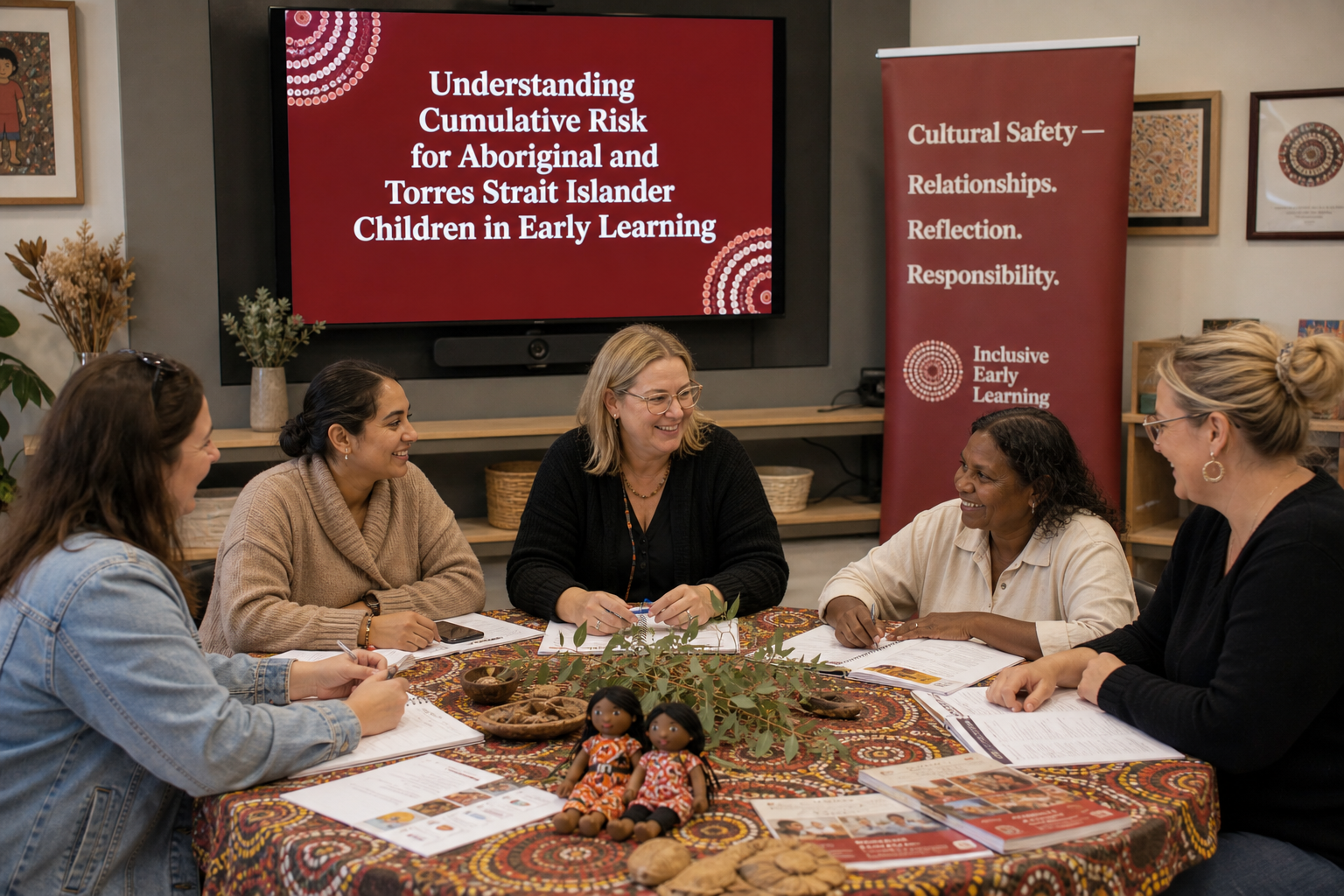
Understanding Cumulative Risk for Aboriginal and Torres Strait Islander Children in Early Learning Understanding Cumulative Risk for Aboriginal and Torres Strait Islander Children in Early Learning
Quick View
Understanding Cumulative Risk for Aboriginal and Torres Strait Islander Children in Early Learning
$0.00

This professional development explores the cumulative risk factors Aboriginal and Torres Strait Islander children may experience in early learning environments, and how these layers of risk can impact safety, connection, participation, wellbeing, and access to learning.

Grounded in culturally responsive and reflective practice, this session supports educators to move beyond tokenistic inclusion and build deeper understanding of how systems, environments, relationships, and unrecognised barriers can affect Aboriginal and Torres Strait Islander children and families.

Rather than viewing risk as belonging to the child or family, this professional development encourages educators to reflect on the ways early learning settings can either increase risk or become a place of safety, strength, and belonging.

What this session covers

• Understanding cumulative risk in early childhood education
• How layered risk can impact Aboriginal and Torres Strait Islander children over time
• The role of systems, bias, exclusion, and disconnection in increasing vulnerability
• Moving beyond tokenistic practice toward meaningful cultural safety
• Reflecting on how environments, routines, expectations, and relationships affect children and families
• Recognising the importance of identity, belonging, community, and connection to culture
• Practical ways to create culturally safe and responsive early learning environments
• Strengthening educator reflection, accountability, and everyday practice

Key Focus
This session focuses on helping educators understand how risk can build across a child’s early experiences when cultural safety, belonging, understanding, and responsive support are missing.

Educators will be supported to reflect on their own practice, recognise how early learning environments can either add to or reduce cumulative risk, and build more culturally safe, respectful, and protective spaces for Aboriginal and Torres Strait Islander children and families.

Who this is for
Early childhood educators, educational leaders, support staff, and early learning teams wanting to strengthen culturally safe practice and deepen their understanding of how layered risk impacts Aboriginal and Torres Strait Islander children in education settings.

Delivery Options

• In-centre professional development
• Team workshops
• Small group training sessions
• Customised sessions tailored to your service

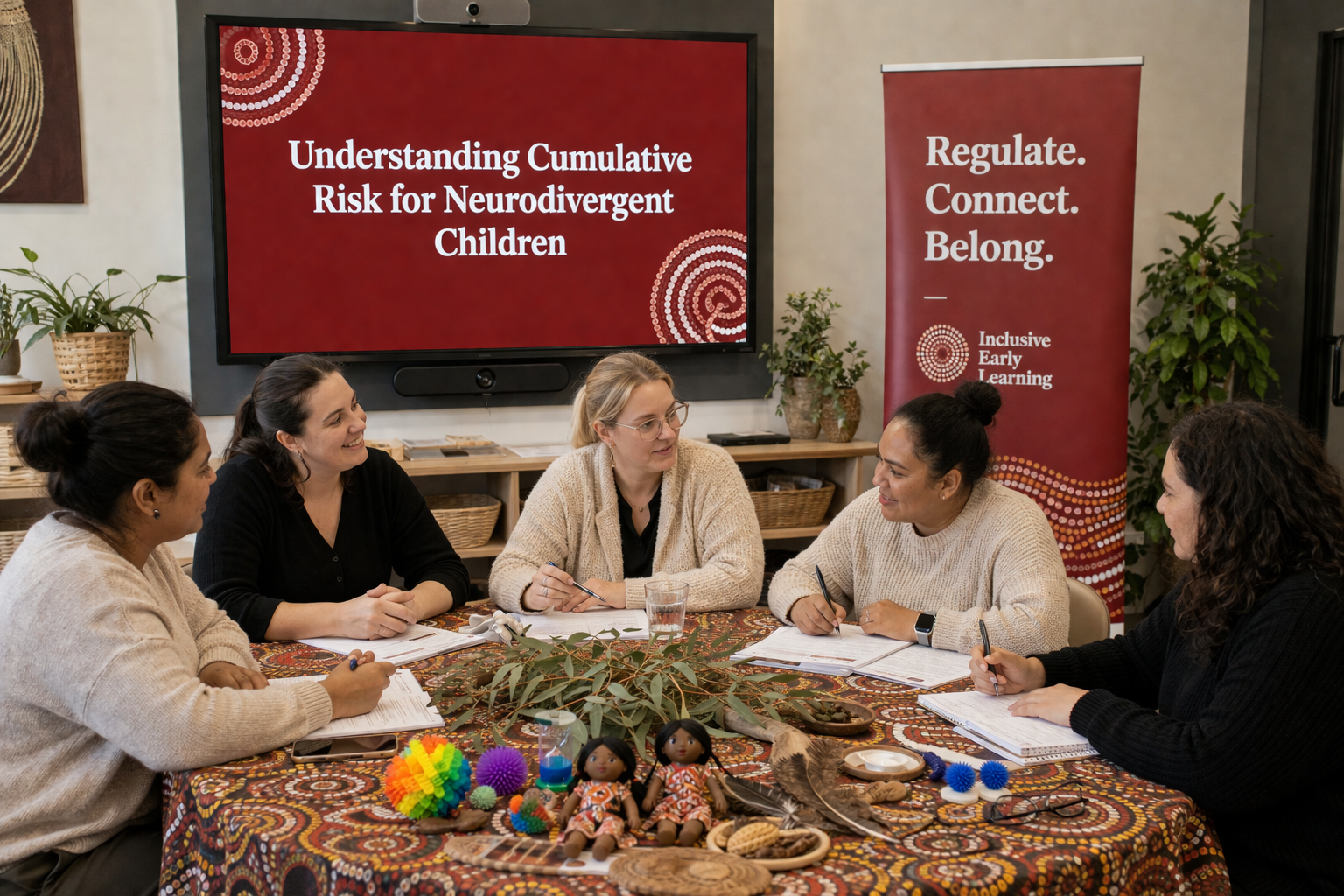
Understanding Cumulative Risk for Neurodivergent Children Understanding Cumulative Risk for Neurodivergent Children
Quick View
Understanding Cumulative Risk for Neurodivergent Children
$0.00

Neurodivergent children often experience risk not from a single event, but from layers of unmet needs, misunderstanding, and environmental mismatch over time.

This professional development explores how cumulative risk builds in early learning environments when sensory, communication, emotional, and developmental needs are not recognised or supported.

Grounded in neuroaffirming practice and lived experience, this session supports educators to shift from viewing behaviour as isolated incidents to understanding the long-term impact of repeated disconnection, overwhelm, and misinterpretation.

What this session covers

• What cumulative risk looks like for neurodivergent children
• How unmet sensory, communication, and emotional needs build over time
• The impact of delayed processing and interoception differences
• How repeated overwhelm affects participation and development
• Why some children are misunderstood or overlooked
• The long-term impact of early learning experiences on identity and wellbeing
• The role of early childhood environments in reducing or increasing risk
• Practical strategies to reduce cumulative stress and support regulation

Key Focus

Understanding how everyday experiences in early learning environments can either contribute to cumulative risk or become protective factors for neurodivergent children.

Who this is for

Educators supporting children with developmental differences, suspected neurodivergence, or children experiencing ongoing dysregulation or difficulty engaging.

High Masking Children in Early Learning High Masking Children in Early Learning
Quick View
High Masking Children in Early Learning
$0.00

This professional development explores high masking in neurodivergent children, focusing on the internal experience of masking, its impact on the nervous system, and how it can present in early learning environments.

What this session covers

• What masking is and why neurodivergent children mask
• Signs of masking in early childhood settings
• Internalised behaviours vs externalised behaviours
• The impact of masking on the nervous system (chronic stress, shutdown, burnout)
• Fight, flight, freeze, and fawn responses in masking children
• How PDA can present in high masking children
• Why masking children are often overlooked or misunderstood
• The risks of late identification and unmet needs
• Creating environments where children feel safe to unmask
• Supporting authentic communication and regulation

Key Focus

Recognising the hidden experiences of children who appear “fine,” and creating environments where they feel safe, supported, and able to express their needs without masking.

Families

Guidance Call
$0.00

A supportive call to unpack your child’s needs and what you’re looking for in an early learning service. We’ll talk through what your current centre can and can’t support (or what you want a new centre to support), and map practical options for what this can look like in the early learning environment. Guidance is aligned to the NQS, EYLF and children’s rights so you feel confident in your next steps.

Childcare Fit Finder Support
$0.00

I help you find an early learning option that genuinely fits your child.
I’ll contact centres in your area, ask the right inclusion questions, check availability for the days you need, and explore alternative options if required (including family day care/in-home care). I can also support you through the application process and attend tours with you, so you’re not navigating it alone.

Kindy–Prep Transition Support
$0.00

Transition support that centres your child and keeps strategies consistent across settings.
I work with your family and early learning service to establish practical transition strategies for starting Prep then adapt these to school systems so your child is supported before, during and after the change.

Meeting Preparation + Advocacy Support
$0.00

Support to advocate clearly and confidently for your child’s needs.
I help you prepare for meetings with early learning services and/or allied health, clarify your goals, and turn them into an actionable plan that fits early learning environments so your requests are realistic, strengths-based and supportive

Early Development Support Early Development Support
Quick View
Early Development Support
$0.00

Developmental Supports is one-to-one, tailored support focused on your child’s individual goals and developmental needs. Sessions are practical, play-based, and neuro-affirming, designed to build skills in a way that feels safe and achievable for your child.

NDIS Supports

Allied Health Therapy Assistant Allied Health Therapy Assistant
Quick View
Allied Health Therapy Assistant
$0.00

Therapy Assistant supports are designed to help your child practise and generalise therapy goals in everyday life, between appointments with their qualified therapist.

I work under the guidance of your child’s treating allied health professional (e.g., Speech Pathologist, Occupational Therapist, Physiotherapist, Psychologist) to implement strategies they have identified. This improves consistency, helps skills “stick”, and supports progress across routines.

Important note: Therapy Assistant support is not a substitute for therapy. I do not diagnose or provide clinical assessment. Support is delivered within scope and linked directly to NDIS goals and/or the treating therapist’s plan.

Skills Development & Training (NDIS) – Goal-Based Capacity Building Skills Development & Training (NDIS) – Goal-Based Capacity Building
Quick View
Skills Development & Training (NDIS) – Goal-Based Capacity Building
$0.00

Skills Development & Training is a capacity building support that helps participants develop practical skills linked to their NDIS plan goals. This service is tailored to the individual child, we focus on the specific skills that will make the biggest difference to participation, independence, and everyday wellbeing.

What this support can help build (examples aligned to goals)

Support is tailored to your child’s goals and may include routines/independence, communication & self-advocacy, self-regulation skills, community participation, and flexibility/transition supports.

Contact Us

Whether you’re a family looking for practical support, or a early childhood education service wanting inclusive systems that are sustainable, i’m here to help.

To help me respond quickly, include:

Are you a family, centre or professional?

What you’d like support with (e.g., inclusion planning, routines, finding the right child care centre for you, supporting your little one with their development goals and NDIS therapy goals.

Location and preferred contact method

After I receive your message, I will be in contact to have our discovery call and discuss how I can best support you!