
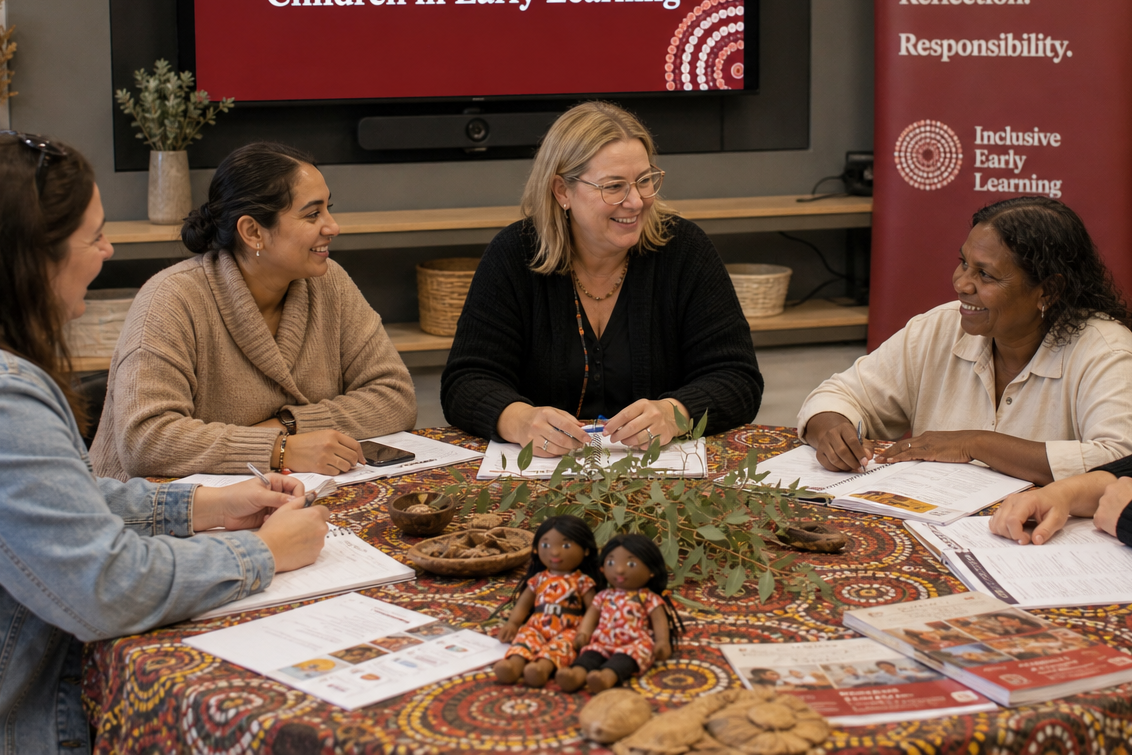
Inclusion that works in real classrooms.
These workshops aren’t a tick-box training. They’re a genuine shift in how educators understand, see, and respond to the children in their care - practical, grounded, and immediately applicable in real classrooms with real ratios.
Professional learning should not end when the workshop does. If you are an individual educator who wants a standing place to bring real questions, access practical resources, and keep building confidence week by week, explore The Inclusion Hub.
Our Most Popular
-
Every Early Childhood service is different - and your professional development should be too.
Before your workshop, I send a tailored intake form directly to your team. Each educator has the opportunity to share what they’re genuinely finding difficult: the children they’re unsure to to support, the situations they don’t have the language for, the gaps they feel in their practice.
I read every response. Then I design your workshop around them.
This means your team gets professional development that speaks directly to their real experience - not a generic slide deck, not a tick and flick session. A workshop built on what your educators are actually sitting with, in the areas I specialise in
Identifying and supporting high masking children in your classroom
Cumulative risk for Aboriginal and Torres Strait Islander children in early childhood settings
Cumulative risk for Neurodivergent children in early childhood settings
Communication, language and AAC in early childhood settings.
-
You don’t need a special day, a themed week, or a brand-new resource pack to embed First Nations culture into your program — you need someone to show you where it already fits.
This service looks at your actual, existing curriculum and finds the natural doorways already there. When your children learn about firefighters, there’s a doorway to First Nations rangers and cultural burning practices. When an ambulance officer visits, there’s a doorway to bush medicine knowledge. These connections aren’t extra content to add on top — they’re already sitting inside what you’re teaching, waiting to be woven in.
What this service includes:
• A review of your current curriculum, routines, and program to identify where First Nations culture and knowledge naturally connects
• Practical, specific suggestions tied to what you’re already doing — not generic resources or one-off activities
• Guidance on embedding culture at the service level, not just the classroom level — from community connection to relationships with local Elders and Aboriginal health services
• A shift from “the little corner” approach to culture being present all year round, without needing to be constant or overwhelming
• Support to distinguish (and value) commemorative days like NAIDOC Week and Reconciliation Week, while building genuine, ongoing practice the rest of the year
This isn’t about doing more — it’s about seeing what’s already there differently, and weaving culture through the program you’ve already built.
Inclusion Consultancy
Tailored consultancy for services ready to build something real
Most early childhood services that reach out don’t lack intention - they have a lack of clarity. These services cut through that.
-
Clarity and direction in a single session.
For centres needing clarity and practical next steps. A focused consult to review your current practices and provide clear, realistic strategies aligned with the EYLF, NQS, and children’s rights. Walk away with an action plan your team can start using straight away.
This is not a compliance audit. It is a collaborative process that gives your team a clear picture of what is actually happening in your environment — and exactly what to do next.
What We Look At:
— Your current environment and routines
— Where children are struggling to participate
— What’s already working and can be built on
— The specific changes that will make the biggest difference
You Walk Away With:
— A clear, honest picture of your current practice
— A prioritised, realistic action plan
— Strategies your team can implement straight away
— Clarity on what funding and support is available
-
Turning good intentions into consistent everyday practice.
Knowing what inclusive practice looks like in theory is one thing. Doing it consistently — across routines, environments, relationships, and the full complexity of a real day — is another. Implementation Support is where real change happens.
I work alongside your team to embed inclusive strategies directly into your daily practice, in a way that feels achievable, sustainable, and genuinely supportive of every child in your care.
We Focus On:
— What will make the biggest difference right now
— Building sustainable, long-term practice
— Supporting your team within real ratios and capacity
Support May Include:
— Predictable routines and transitions
— Visual supports used meaningfully
— Sensory and environmental adjustments
— Communication foundations including AAC
-
Sustained support that builds real inclusive culture over time.
A one-off training day changes attitudes. It rarely changes culture. Culture changes when the same values are reinforced, the same language is used, and the same approach is modelled — consistently, over time. Ongoing Consultancy is the support that makes that possible.
Regular, responsive, relationship-based support for your service — adapting to what your team actually needs as your cohort changes, challenges arise, and educators grow in confidence and capacity.
Regular check-ins · Responsive troubleshooting · Team capacity building · Documentation & planning support ·
Early childhood educators are the gate openers to access. When inclusive practice is embedded early - through environment, relationships, routines, and co-regulation - children don’t just cope. They belong, participate, and learn in ways that honour who they are.
- Annissa, Founder
Professional Development
There is a lot of professional development available in early childhood. Most of it is forgotten within a fortnight. What makes the difference isn’t more information — it’s a shift in how educators understand children.
-
Early intervention isn’t something that just happens to a child in a therapy room — it happens in the room you’re already in, every day.
This workshop redefines what “early intervention educator” really means: not a diagnosis, not a title, but a role every educator already has the power to step into.
Early intervention is already part of your qualification — it’s just scattered across units and easy to miss in isolation. This workshop pulls those threads together from across the CHC50121 Diploma of Early Childhood Education and Care, reconnects them to the theory they were built on, and shows you how to apply them as one connected practice — not separate boxes to tick.
Where early intervention lives in your diploma — and the theory behind it:
• CHCECE042 – Foster holistic early childhood learning, development and wellbeing
→ Grounded in Piaget’s Cognitive Development Theory: how to read development across domains in real time, and recognise when a child’s development is tracking differently from expected stages — and what that does and doesn’t mean
• CHCECE046 – Implement strategies for the inclusion of all children
→ Grounded in Bronfenbrenner’s Ecological Systems Theory: practical, everyday inclusion strategies that double as early intervention, understanding a child’s development in the context of family, service, and community — no diagnosis required to start
• CHCECE047 – Analyse information to inform children’s learning
→ Grounded in Vygotsky’s Sociocultural Theory: using the Zone of Proximal Development to turn what you notice into meaningful, documented observations that support families and referrals
• CHCECE045 – Foster positive and respectful interactions and behaviour in children
→ Grounded in Maslow’s Hierarchy of Needs: understanding behaviour as communication of unmet needs, and responding in ways that regulate rather than escalate
• CHCECE050 – Work in partnership with children’s families
→ Grounded in Bowlby & Ainsworth’s Attachment Theory: how secure relationships shape a child’s capacity to regulate, explore, and learn — and how to raise concerns with families early, clearly, and without alarm
• CHCECE048 – Plan and implement children’s education and care curriculum
→ Grounded in Vygotsky’s Scaffolding: embedding early intervention strategies into everyday curriculum as scaffolded support, not extras bolted on top
• CHCPRP003 – Reflect on and improve own professional practice
→ Grounded in reflective practice as the thread connecting all of the above: building the confidence to act on what you notice, rather than waiting for someone else to
By the end, educators walk away seeing themselves differently: not bystanders to a child’s development, but the first and most consistent early intervention this child will ever have — understanding both the why behind their practice and the how to act on it, using skills and theory already sitting inside the qualification they hold.
-
Cumulative risk isn’t one big event — it’s the slow build-up of small, repeated experiences of a system not quite fitting a child.
Understood in isolation, individual risk factors can look manageable. Understood cumulatively, they tell a very different story about why some children are so much more vulnerable in our services than others.
The Educator’s Position: Risk Factor or Protective Factor
Early childhood education isn’t neutral. For a First Nations child, a neurodivergent child, or both, the service itself can be a risk factor — one more environment where they’re misread, excluded, or asked to fit a mould that was never built for them. Every day in the room, educators are either adding to a child’s cumulative risk or actively protecting against it. There’s no middle, invisible option.
• How the “safe, universal” service can still be a risk factor — even well-intentioned, compliant services can compound risk through deficit-based observation, inconsistent cultural safety, or environments that assume a neurotypical, culturally mainstream child as the default
• What “protective factor” actually requires of educators — not just avoiding harm, but actively building relationship, safety, and belonging that counteracts risk accumulated elsewhere in a child’s life
• Recognising your own practice on the spectrum — a practical, honest look at where current practice sits between risk factor and protective factor, without shame, as a starting point for change
• The educator as buffer — how consistent, attuned, culturally safe and neuro-affirming practice in the early years can meaningfully offset risk building up in other parts of a child’s world
• Why this responsibility can’t be outsourced — waiting for a specialist, a diagnosis, or a policy update to arrive before acting on this is itself part of the risk factor
Cumulative Risk for First Nations Children
• Intergenerational trauma and system mistrust — how historical harm from institutions shapes present-day engagement with education and care services, and why “non-compliance” or disengagement is often self-protection, not disinterest
• Cultural safety vs cultural tokenism — the difference between genuinely embedding culture and performing it on special days, and why the gap between the two is itself a risk factor
• Deficit-based assessment and observation practices — how Western developmental benchmarks can misread culturally different ways of communicating, relating, and learning as delay or deficit
• Disconnection from Country, language, and kinship structures — the compounding effect of a child not seeing their identity reflected in the service they spend their days in
• The cumulative weight of “small” exclusions — what happens over months and years when culturally responsive practice is inconsistent rather than embedded
Cumulative Risk for Neurodivergent Children
• Masking and the hidden cost of “coping well” — why a child who appears to be managing may be accumulating risk invisibly, and what high masking and PDA profiles actually look like day to day
• Sensory and interoceptive mismatch — how repeated sensory overwhelm in environments not built for a neurodivergent nervous system compounds over time
• Communication misattunement — what happens when AAC, gestalt language processing, or non-typical communication styles go unrecognised or unsupported
• Behaviour interpreted as defiance rather than dysregulation — the compounding harm of repeated misreading, and what it teaches a child about themselves
• The gap between diagnosis and daily support — why having a label doesn’t automatically mean the environment has adapted around it
Where the Two Intertwine: When Risk Triples
When a child is both First Nations and neurodivergent, the risk isn’t cultural risk plus neurodivergent risk — it’s a third, compounded layer on top of both. Each dimension doesn’t just sit alongside the other; it multiplies it, and that multiplication creates additional layers of support the child actually needs.
• Why two risk factors don’t add — they triple. A sensory need dismissed as cultural difference isn’t one missed support, it’s two — and the child now carries the weight of both, plus the harm of being misread twice
• The third layer: identity and belonging — beyond the cultural risk and the neurodivergent risk sits a third, separate layer — a child trying to work out who they are when neither part of their identity is being fully seen or supported
• What “more support” actually means in practice — not doubling up on generic strategies, but recognising that this child needs support that holds culture and neurodivergence together at the same time
• Why single-lens services under-support these children — a service strong on cultural safety but blind to neurodivergence, or strong on neuro-affirming practice but blind to culture, still leaves this third layer completely unsupported
• Building a support response sized to the actual risk — practical strategies for increasing support intensity and layering it appropriately, rather than assuming standard-level support will stretch to cover triple the risk
By the end, educators walk away with a framework for seeing risk cumulatively rather than in isolated incidents — and the confidence to move from being a risk factor to being the protective factor a child needs, at every layer of who they are.